Open Data
Mapping Power: How EveryPolitician Uses Wikidata to Make Global Political Networks Visible


Zarah Ziadi
20. July 2026
Understanding who holds political power — and how roles, institutions, and individuals are connected — is fundamental to any functioning democracy. Yet in practice, this information is often fragmented, inconsistent, and difficult to work with, especially across countries and systems.
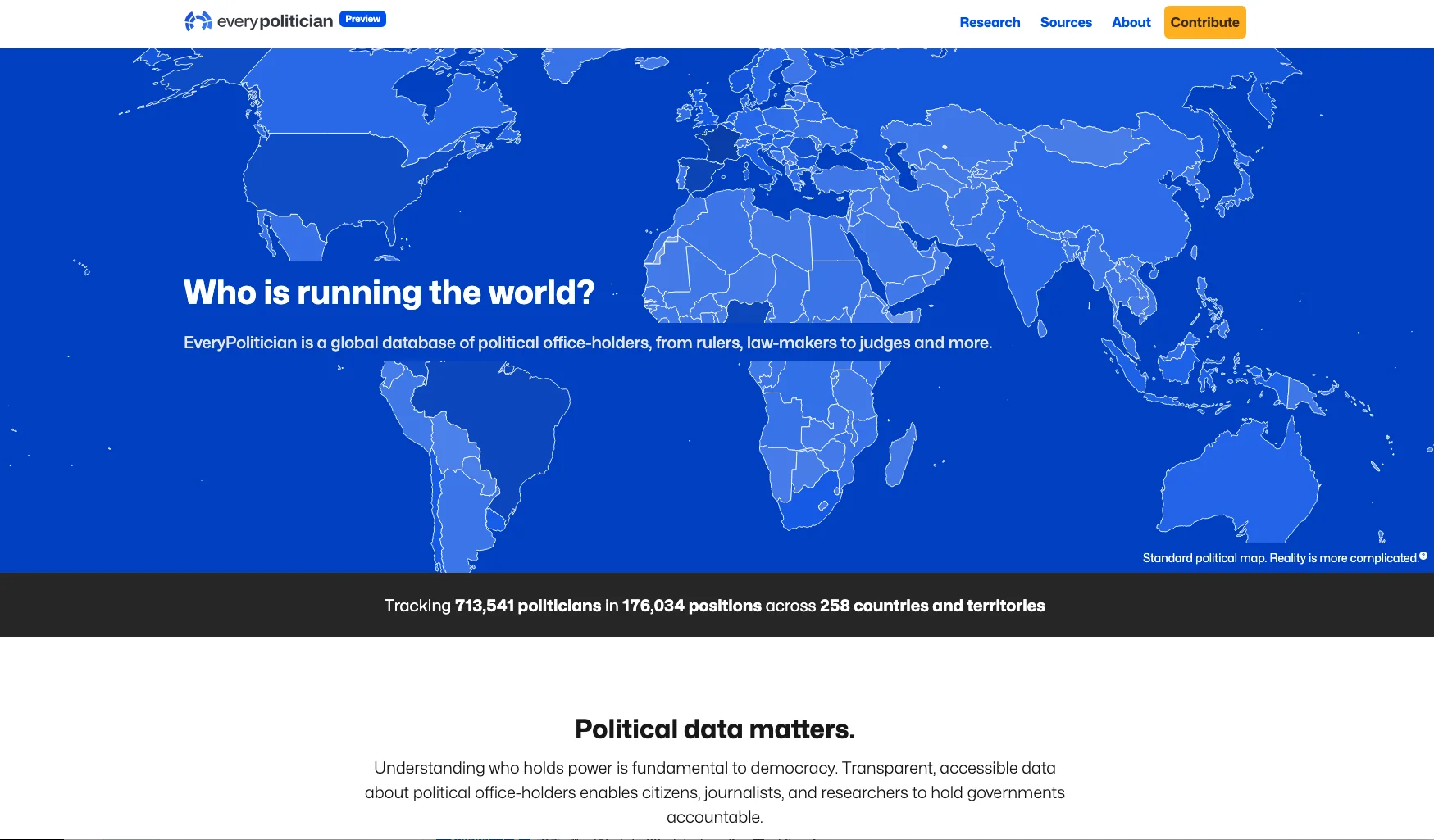
With EveryPolitician, OpenSanctions is working to change that. The project aims to build a global, structured dataset of political officeholders — from rulers and lawmakers to judges and more. With currently over 720,000 entries, the database creates a foundation for transparency, research, and accountability. Drawing in part on Wikidata, it connects scattered public data into a coherent, queryable knowledge graph.

We spoke with Johan Schuijt, who leads EveryPolitician, about how the project came to life, what makes it different from traditional datasets, and why open knowledge infrastructures are key to understanding power in a complex, data-driven world.
The EveryPolitician project aims to map political officeholders globally. How did the idea for the project come about?
The current iteration of EveryPolitician was born of an earlier project by the UK nonprofit mySociety. It was based on the simple idea of gathering accurate, up-to-date data on every political officeholder in the world and collating and sharing it in a consistent, free, and accessible format. That early version of EveryPolitician was paused in 2019 because the overwhelming task of gathering up-to-date parliamentary data could not be sustained in a grant-funded setting.
OpenSanctions took over the project earlier this year, and we’re staying true to mySociety’s original vision, keeping it community-focused and contributor-driven. It also ties in heavily with our work at OpenSanctions and is a way for us to expand and deepen our data on Politically Exposed Persons (PEPs) that is used by financial services companies for Anti-Money Laundering (AML) checks.
You’ve described tracking political officeholders as a foundation for accountability. Why is it so important that citizens can clearly see who holds which roles and powers?
No matter where we live in the world, we are all impacted by political policy. Knowing who is responsible for building and shaping those policies is knowledge that every citizen should be entitled to.
Providing access to that data is a first step, but beyond that, we’re also keen to build and maintain a database that feeds into key accountability mechanisms and compliance workflows with real-world impact — from anti-corruption and anti-money laundering efforts to cross-border investigative journalism. We see this data as part of a broader effort to combat financial crime and political corruption.
There are already various datasets on politicians and public officials. What makes EveryPolitician different from other initiatives?
I think the main thing that sets us apart is the fact that we aggregate data from so many different sources and try to make them align. The other thing is our openness — there are more comprehensive datasets out there, but they often come with a price tag attached and are not necessarily accessible to journalists or civil society organisations. At EveryPolitician, every entity is fully browsable on our website, so there’s no paywall or barrier to access.
The other thing that sets us apart is being open-source in an industry where this level of auditability isn’t the norm. Our methodology is published online, and compliance teams can trace any data point back to its source.
What changes when you move from fragmented lists of officials to a structured, connected dataset? What kinds of insights become possible?
Everything changes. There’s only so much you can gauge from separate, siloed sources, because they aren’t comparable. It’s essentially a problem of language — we need to find a common data model that can speak intelligently to the structure of hundreds of political systems, and that’s a really fun problem to have.
When these datasets are cleaned, deduplicated, and aggregated into a single structured, connected dataset, patterns and anomalies surface, opening opportunities for deeper analysis.
Political data is often incomplete, inconsistent, and spread across many sources. What are the biggest challenges in collecting and structuring this information globally?
Documenting the world’s politicians is a task bigger than any engineering team’s capacity. Elections are frequent, reshuffles are common, and some parliamentary websites are updated more than others.
In a sense, political data is itself political — different countries have different systems, terminology, and ways of classifying roles. Defining who or what counts as a politician is hard, and mapping these different sources and roles into a single schema requires judgment calls that are both technically challenging and politically sensitive.
Systemic bias is a persistent issue that manifests in PEP coverage. While well-known politicians in the US may have detailed entries, others in smaller, less digitally documented nations are often incomplete. English-language sources dominate, and wealthier democracies with stronger civic tech communities have the resources to publish more data.
There is no single solution to these challenges, but we think that allowing contributors to easily and quickly add sources is the first step. We’d like to reduce the tedium of contributing by automating what we can, making it as simple as possible for people around the world to contribute to the project.
At the moment, we receive strong support from the existing Wikidata community and the OpenSanctions user community. Our long-term goal, however, is to gradually build a global community of contributors.

How do you approach entity resolution or solve disambiguation in this context — making sure that different records actually refer to the same person across countries, languages, and systems?
Matching names and identities is more than just a technical challenge. The data itself contains cultural, linguistic, and legal ambiguities that need to be taken into account. Within the OpenSanctions pipeline, the goal is to establish reliable links between people and organisations across different data sources.
To achieve this, the process begins with a technique called blocking, which efficiently identifies records that are likely to refer to the same entity. These candidate matches are then evaluated by the open-source matching engine nomenklatura, which compares multiple attributes, cleans inconsistent or messy data, and helps establish links between different datasets. This makes it possible to combine information from multiple sources and uncover relationships that would otherwise remain hidden. In addition, we are exploring how large language models (LLMs) can serve as an additional verification layer to further improve the matching process.
In entity resolution (the process of identifying, matching, and linking disparate data records that refer to the same real-world entity, such as a person or company), blocking refers to the process of building small buckets (or blocks) of entities that are known to have some shared properties, like phone numbers, name parts, tax numbers or other details. A more in-depth explaination of this process can be found here.
Upstream of this process is PoliLoom, our LLM-based tool designed to extract structured knowledge from incomplete or unstructured information. For example, it extracts information from natural-language sources such as Wikipedia articles and converts it into structured data in Wikidata, making it available for further use throughout the data pipeline.
To map this extracted information to existing Wikidata items, PoliLoom combines keyword-based and semantic search in a hybrid search approach. Based on these results, it suggests matching entities and categories, which are then reviewed and verified by members of the Wikidata community.
The two components complement each other while serving distinct purposes: PoliLoom transforms knowledge from unstructured sources into structured data, whereas the blocking and matching system ensures that this and other structured data can be reliably linked across different datasets.
EveryPolitician builds in part on Wikidata. What makes Wikidata the right foundation for this project?
Wikidata offers a scale and breadth of data that no single engineering team can tackle. Its community-focused approach and collaborative nature mean that profiles are incredibly detailed, often going beyond basic information like birth dates and political roles, and providing rich name variations across dozens of alphabets, as well as details of family relationships.
Another key benefit of Wikidata is that items are almost perfectly deduplicated thanks to their identifiers, enabling all language-specific Wikipedia articles on the subject to link to the item. You’ll notice that we use the same QIDs (Q-Identifiers) to match persons of interest who appear in OpenSanctions.
How does working with Wikidata shape your workflow in practice? Where does it help the most, and where do you still encounter challenges?
Our PoliLoom tool is 100% built on Wikidata. We believe the challenge of mapping out the world’s political landscape — with political positions and holders continually changing — can only be met with the help of the global community. Wikidata gives us a great starting point: it already contains a substantial number of political positions and politicians and has a strong contributor community.
To make contributions as easy as possible, we make use of the Wikidata login system, so accepted edits are contributed to Wikidata under the user’s own account. Then, from Wikidata, the data flows back into the main EveryPolitician database. Wikidata is the backbone.
The biggest challenges with the existing Wikidata data originate from the same root as its strength. Volunteers around the world contribute to Wikidata, which means that not everything is modelled consistently. The way entities are classified, and whole parts of the classification system, can change. This makes it hard to build a consistent system on top of data that’s constantly shifting.
Looking ahead, do you see untapped potential in Wikidata for other projects like EveryPolitician?
Any project that wants to improve the structured data understanding of the world could benefit from modelling its domain in Wikidata. The Wikidata model is often highly detailed, which can save teams a lot of time rather than modelling their domain from scratch. There is also some degree of cross-pollination in this type of project. Your own community can help expand Wikidata, and the existing Wikidata community can help map out your domain.
Who are the main users of EveryPolitician, and how is the data being used in practice — by journalists, researchers, and civil society?
Our PEP data is mainly used by compliance teams through the OpenSanctions database. This data forms part of Know Your Customer (KYC) and Anti-Money Laundering (AML) screening and due diligence workflows and plays an important role in fighting financial crime and corruption. Journalists, academics, and civil society organisations are also showing interest in the data – how they use that data will become clearer as the project progresses.

If you could make one wish for the future of the open data ecosystem, especially around political data, what would it be?
My wish would be for more organisations to join in the effort to document and map the world’s political officeholders and lawmakers. It’s a huge task — institutions and their positions change all the time, and many countries don’t even have a clear definition of what constitutes a politician.
If we want to understand who holds power and how that power is used, we need to work together. Wikidata is the perfect foundation for that.