Tools for Wikidata
Making Wikidata’s trickiest data easier to edit, one small task at a time

Zita Zage
19. August 2026
For a long time, Wikidata contributors felt the lack of one crucial capability: effective editing on mobile. Now the Jakarta-based Wikicollabs team has delivered just such a tool — Lexica — by doing something unexpected: keeping it simple.
In an interview with them on July 25, 2026, Wikicollabs told us, “We deliberately kept Lexica focused on small, repeatable tasks so contributors would have a clear and manageable place to begin.”
From the start, the Wikicollabs team behind Lexica made clear their meticulous approach to open data. Rather than trying to solve all of Wikidata’s lexicographical challenges at once, they built a tool that breaks a single edit down into something anyone can finish in a few taps — even on a phone, even without knowing what a Lexeme is.
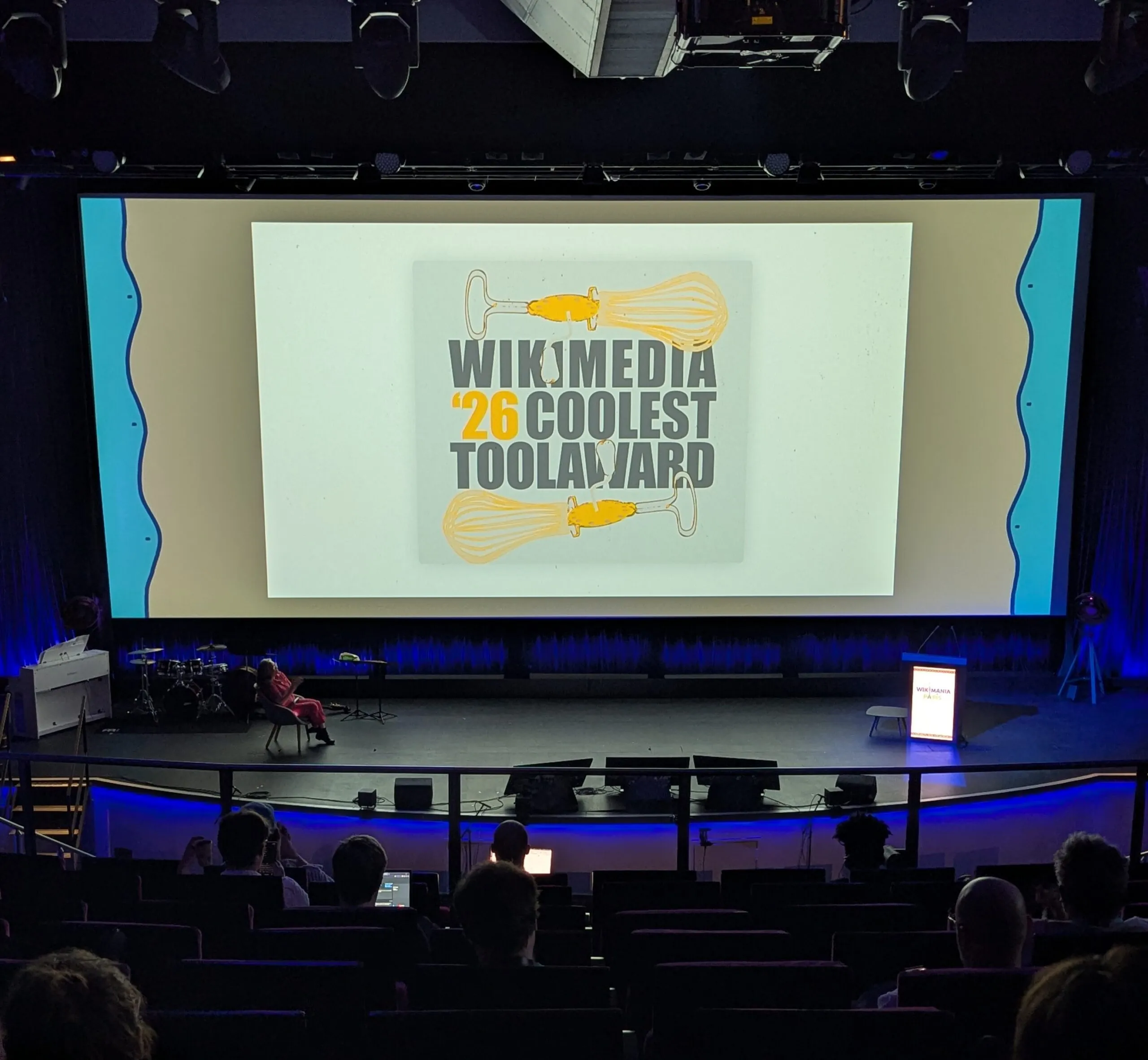
Lexica was recognized at this year’s Coolest Tools Award ceremony at Wikimania Paris, acknowledging its quiet but steady impact on how people contribute to one of Wikidata’s most tricky corners: lexicographical data.
What lexicographical data is and why it matters
To understand what Lexica is trying to fix, it helps to understand Wikidata’s lexicographical data first. Wikidata launched in 2012 as a structured companion to Wikipedia. Unlike Wikipedia, Wikidata’s data is stored in sequentially numbered entities whose IDs (known as QIDs) have nothing to do with the name of the thing discussed. For its first several years, Wikidata dealt almost entirely in things or ideas, like “dog” or “democracy”, without making reference to the words used to describe them. But in May 2018, Wikidata introduced a new kind of entity to capture the words themselves: Lexemes.
Lexemes group together related word forms; for example, run, runs, ran, and running are all variations of the same English Lexeme. A Lexeme can carry multiple senses (its various meanings), forms (its grammatical variants), and also statements describing pronunciation, hyphenation, and more.
This structured, linked approach to language data has grown into one of the more significant data projects in the Wikimedia movement. Because Lexemes are open, multilingual, and machine-readable, they’ve become a resource other tools and researchers can build on, from supporting keyboard apps for language learners to feeding natural language processing research to powering Wiktionary entries.
The catch is that this richness comes with real complexity: modeling a language accurately means grappling with a complex data structure.
A simpler way into a complex data model
The gap between the importance of the data and the complexity of contributing to it is exactly what Lexica was designed to close.
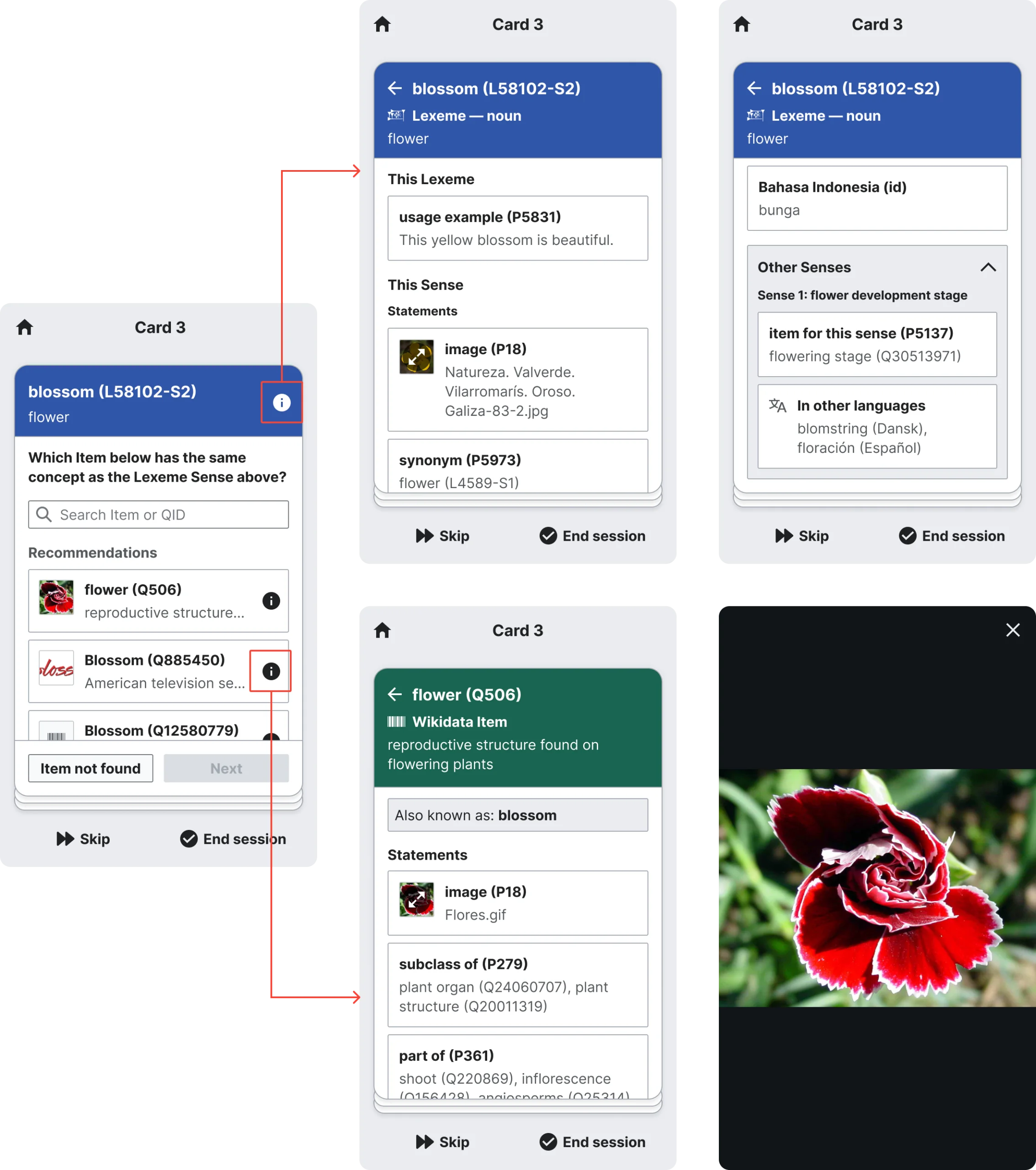
Lexica allows mobile users to contribute lexicographical data to Wikidata by walking them through guided activities, like linking a Sense to a Wikidata Item or adding script variants and hyphenation, turning what used to be a complex editing task into a short, focused action.
The idea for Lexica grew out of research into who exactly was struggling to contribute and why.
Our research found that contributing to Wikidata Lexemes could be difficult, particularly for contributors using mobile devices or those unfamiliar with the Lexeme data model.the Wikicollabs team
That finding pointed the team toward a simpler workflow, one that divides an edit into clear, manageable steps instead of asking a newcomer to absorb an entire data model before making a single change.
Editing Lexemes directly on Wikidata requires contributors to understand concepts such as Lexemes, Senses, Forms, and their related properties before making what often ends up being a relatively small edit. Lexica removes that initial hurdle. It lets contributors focus on one task at a time, provides the information needed for each decision, lets them review their changes before saving, and even lets them skip an entry when they’re unsure. The Wikicollabs team notes, “This helps contributors make careful edits without being overwhelmed by the full data model.”
Built in five months, shaped over five more
The Wikicollabs team began development in June 2024, and the first version of Lexica launched on 29 October 2024, on the occasion of Wikidata’s twelfth birthday. Initial development and testing took around five months, after which the team added more contribution activities and expanded language support. Further improvements kept coming based on feedback and real-world use.
Two challenges stood out for the team along the way. The first was linguistic: different languages carry their own structures, writing systems, and modeling needs, which don’t always fit neatly into one standardized workflow. Balancing that diversity against the need for clean, structured data requires constant adjustment.
The second challenge was more about discipline than design. “Another important challenge was resisting scope creep,” the team said. “We deliberately kept Lexica focused on small, repeatable tasks so contributors would have a clear and manageable place to begin.”
The team behind the tool
Lexica isn’t the only tool that has come out of the industrious Jakarta-based Wikicollabs. They conduct user research, design prototypes, and develop open source tools for Wikidata. In addition to Lexica, the team also developed Broomstick and is now testing a new, Broomstick-complementary tool for WikiProjects called Dustpan. Dustpan can be tested on WikiCollabs staging and functions much like Broomstick, querying for missing metadata on WikiProject-connected items. Dustpan was developed for and unveiled at the recent Wikidata WikiProjects Days event. (The session video recording is available on Commons.)
The team’s origins trace back to the Software Collaboration for Wikidata project. “Our team originally came together for the Software Collaboration for Wikidata project. Wikicollabs was established through the trust given by Wikimedia Deutschland. This trust enabled us to continue our work as a dedicated team.”
Gratitude and an invitation to contribute
The team received the news of the Coolest Tools Award with gratitude. “We are grateful and honored that Lexica is being recognized at this year’s Coolest Tools Award ceremony,” the team said. “This recognition means a great deal to our team at Wikicollabs and to everyone who contributed feedback and supported its development.
They were quick to credit the wider community that made the tool possible, especially the Wikidata community and Wikimedia Deutschland, whose support came through their Software Collaboration for Wikidata (Wiki N.O.D.E.).
Looking ahead, the Wikicollabs team hopes that this kind of recognition will create more contributors, not so that they can master a data model, but because they no longer need to. “We hope this recognition encourages more people to contribute, one small edit at a time.”